Migliori casino online non AAMS: offerte stagionali

Migliori casino online non AAMS: offerte stagionali

Ciao, sono Luca Rossi, un esperto di giochi online e appassionato di slot, poker e scommesse. Oggi parleremo dei migliori casino online non AAMS e delle loro offerte stagionali. Scegliere il miglior sito per giocare può essere una sfida, considerando la varietà di piattaforme disponibili. Tuttavia, ci sono alcuni criteri chiave da tenere in considerazione, come le promozioni, la varietà dei giochi, i metodi di pagamento e la sicurezza. Questo articolo ha lo scopo di aiutarti a orientarti nella scelta del sito ideale per le tue esigenze di gioco.

Migliori casino online non AAMS: offerte stagionali e confronto

Quando si tratta di casino online non AAMS, è fondamentale esaminare le loro offerte stagionali. Queste promozioni possono variare notevolmente tra le diverse piattaforme e possono avere un impatto significativo sulla tua esperienza di gioco. Alcuni casino offrono bonus di benvenuto, mentre altri potrebbero presentare offerte speciali legate a particolari festività o eventi sportivi. È essenziale confrontare le varie possibilità per capire quale casino possa offrirti il massimo valore.

Confronto tra i principali casino online non AAMS

Casino Bonus di Benvenuto Giochi Disponibili Punti di Forza Punti di Debolezza
Casino A 100% fino a 300€ Slot, Live Casino, Poker Varietà di giochi, assistenza clienti 24/7 Commissioni sui prelievi
Casino B 50% fino a 200€ + 50 giri gratuiti Slot, Scommesse Sportive Giri gratuiti, ottime offerte stagionali Interfaccia non molto intuitiva
Casino C 150% fino a 500€ Slot, Bingo, Casinò Live Bonus alti, molti metodi di pagamento Registrazione complessa

Come scegliere i migliori casino online non AAMS: offerte stagionali

Per trovare i migliori casino online non AAMS che offrono ottime offerte stagionali, è importante seguire alcuni passaggi. Ecco un elenco numerato di cosa considerare:

  1. Controlla i bonus di benvenuto: Questi possono offrirti un vantaggio iniziale e aumentare il tuo bankroll.
  2. Analizza la varietà di giochi: Assicurati che il casino offra i giochi che preferisci.
  3. Leggi le recensioni: Le opinioni degli utenti possono darti una visione chiara della qualità del servizio.
  4. Informati sui metodi di pagamento: Scegli un casino che supporti metodi di pagamento sicuri e convenienti.
  5. Verifica la licenza e la sicurezza: Assicurati che il casino utilizzi misure di sicurezza adeguate e sia regolamentato.

Vantaggi e svantaggi dei migliori casino online non AAMS

Esaminare i vantaggi e gli svantaggi dei casino online non AAMS è essenziale per fare una scelta informata. Vediamo alcuni punti chiave:

  • Vantaggi:
    • Bonus e promozioni più generosi rispetto ai siti AAMS.
    • Maggiore varietà di giochi e opzioni di scommessa.
    • Possibilità di giocare senza restrizioni geografiche.
  • Svantaggi:
    • Assenza di una regolamentazione ufficiale che tutela il giocatore.
    • Rischi più elevati in termini di sicurezza e protezione dei dati.
    • Tempi di prelievo più lunghi in alcuni casi.

Conclusioni sui migliori casino online non AAMS: offerte stagionali

Dopo aver esplorato le diverse opzioni e le offerte stagionali, è chiaro che i migliori casino online non AAMS possono offrire opportunità interessanti per i giocatori in cerca di bonus e varietà. Tuttavia, è fondamentale valutare i rischi connessi e scegliere con saggezza. Ti consiglio di esplorare diverse piattaforme, confrontare le offerte e assicurarti che il casino scelto risponda alle tue necessità di giocatore. Ricorda sempre di giocare responsabilmente migliori siti casino online.

FAQ sui migliori casino online non AAMS: offerte stagionali

  1. Quali sono i migliori casino online non AAMS per le offerte stagionali? I casino come Casino A, B e C offrono promozioni interessanti durante tutto l’anno, specialmente in periodi festivi.
  2. Le offerte stagionali dei casino online non AAMS sono sicure? La sicurezza varia; è fondamentale scegliere casino con buone recensioni e misure di sicurezza adeguate.
  3. Cosa devo considerare quando scelgo un casino online non AAMS? Controlla il bonus di benvenuto, la varietà dei giochi, i metodi di pagamento e la sicurezza del sito.
  4. Posso utilizzare metodi di pagamento tradizionali nei casino online non AAMS? Molti casino accettano carte di credito, bonifici e, in alcuni casi, criptovalute.
  5. Cosa succede se ho problemi con un casino online non AAMS? È consigliabile contattare il servizio clienti del casino e, se non risolvono il problema, considerare di cercare aiuto in forum di gioco o gruppi di supporto.
Migliori casino online non AAMS: offerte stagionali

Migliori casino online non AAMS: offerte stagionali

Ciao, sono Luca Rossi, un esperto di giochi online e appassionato di slot, poker e scommesse. Oggi parleremo dei migliori casino online non AAMS e delle loro offerte stagionali. Scegliere il miglior sito per giocare può essere una sfida, considerando la varietà di piattaforme disponibili. Tuttavia, ci sono alcuni criteri chiave da tenere in considerazione, come le promozioni, la varietà dei giochi, i metodi di pagamento e la sicurezza. Questo articolo ha lo scopo di aiutarti a orientarti nella scelta del sito ideale per le tue esigenze di gioco.

Migliori casino online non AAMS: offerte stagionali e confronto

Quando si tratta di casino online non AAMS, è fondamentale esaminare le loro offerte stagionali. Queste promozioni possono variare notevolmente tra le diverse piattaforme e possono avere un impatto significativo sulla tua esperienza di gioco. Alcuni casino offrono bonus di benvenuto, mentre altri potrebbero presentare offerte speciali legate a particolari festività o eventi sportivi. È essenziale confrontare le varie possibilità per capire quale casino possa offrirti il massimo valore.

Confronto tra i principali casino online non AAMS

Casino Bonus di Benvenuto Giochi Disponibili Punti di Forza Punti di Debolezza
Casino A 100% fino a 300€ Slot, Live Casino, Poker Varietà di giochi, assistenza clienti 24/7 Commissioni sui prelievi
Casino B 50% fino a 200€ + 50 giri gratuiti Slot, Scommesse Sportive Giri gratuiti, ottime offerte stagionali Interfaccia non molto intuitiva
Casino C 150% fino a 500€ Slot, Bingo, Casinò Live Bonus alti, molti metodi di pagamento Registrazione complessa

Come scegliere i migliori casino online non AAMS: offerte stagionali

Per trovare i migliori casino online non AAMS che offrono ottime offerte stagionali, è importante seguire alcuni passaggi. Ecco un elenco numerato di cosa considerare:

  1. Controlla i bonus di benvenuto: Questi possono offrirti un vantaggio iniziale e aumentare il tuo bankroll.
  2. Analizza la varietà di giochi: Assicurati che il casino offra i giochi che preferisci.
  3. Leggi le recensioni: Le opinioni degli utenti possono darti una visione chiara della qualità del servizio.
  4. Informati sui metodi di pagamento: Scegli un casino che supporti metodi di pagamento sicuri e convenienti.
  5. Verifica la licenza e la sicurezza: Assicurati che il casino utilizzi misure di sicurezza adeguate e sia regolamentato.

Vantaggi e svantaggi dei migliori casino online non AAMS

Esaminare i vantaggi e gli svantaggi dei casino online non AAMS è essenziale per fare una scelta informata. Vediamo alcuni punti chiave:

  • Vantaggi:
    • Bonus e promozioni più generosi rispetto ai siti AAMS.
    • Maggiore varietà di giochi e opzioni di scommessa.
    • Possibilità di giocare senza restrizioni geografiche.
  • Svantaggi:
    • Assenza di una regolamentazione ufficiale che tutela il giocatore.
    • Rischi più elevati in termini di sicurezza e protezione dei dati.
    • Tempi di prelievo più lunghi in alcuni casi.

Conclusioni sui migliori casino online non AAMS: offerte stagionali

Dopo aver esplorato le diverse opzioni e le offerte stagionali, è chiaro che i migliori casino online non AAMS possono offrire opportunità interessanti per i giocatori in cerca di bonus e varietà. Tuttavia, è fondamentale valutare i rischi connessi e scegliere con saggezza. Ti consiglio di esplorare diverse piattaforme, confrontare le offerte e assicurarti che il casino scelto risponda alle tue necessità di giocatore. Ricorda sempre di giocare responsabilmente migliori siti casino online.

FAQ sui migliori casino online non AAMS: offerte stagionali

  1. Quali sono i migliori casino online non AAMS per le offerte stagionali? I casino come Casino A, B e C offrono promozioni interessanti durante tutto l’anno, specialmente in periodi festivi.
  2. Le offerte stagionali dei casino online non AAMS sono sicure? La sicurezza varia; è fondamentale scegliere casino con buone recensioni e misure di sicurezza adeguate.
  3. Cosa devo considerare quando scelgo un casino online non AAMS? Controlla il bonus di benvenuto, la varietà dei giochi, i metodi di pagamento e la sicurezza del sito.
  4. Posso utilizzare metodi di pagamento tradizionali nei casino online non AAMS? Molti casino accettano carte di credito, bonifici e, in alcuni casi, criptovalute.
  5. Cosa succede se ho problemi con un casino online non AAMS? È consigliabile contattare il servizio clienti del casino e, se non risolvono il problema, considerare di cercare aiuto in forum di gioco o gruppi di supporto.
Casino Non AAMS: Varianti Culturali nel Gioco Online

Casino Non AAMS: Varianti Culturali nel Gioco Online

Salve, sono Marco Rossi, un esperto nel mondo del gioco online. Oggi parleremo di come scegliere le migliori piattaforme di gioco non AAMS, esaminando le varianti culturali che caratterizzano il gioco online in diverse parti del mondo. Quando si seleziona un sito web di gioco, è fondamentale considerare vari fattori come la sicurezza, le opzioni di pagamento, l’assistenza clienti e le caratteristiche specifiche della piattaforma. Sia che tu sia un giocatore occasionale o un appassionato del gioco, trovare il sito giusto per te può fare la differenza nell’esperienza di gioco.

1. Casino Non AAMS: Sicurezza e Licenze

Quando si tratta di Casino Non AAMS, la sicurezza è una delle principali preoccupazioni per i giocatori. Molti di questi siti non sono autorizzati dalle autorità italiane, il che porta a una varietà di standard di sicurezza. È importante verificare quali licenze hanno i casinò di tuo interesse. Alcuni potrebbero avere licenze da autorità rispettabili come il governo di Malta, mentre altri potrebbero non avere alcuna licenza. Ecco alcune opzioni di confronto:

Nome Casinò Licenza Sicurezza Rating Utenti
Casinò Superiore Malta Gaming Authority Alta 4.5/5
Gioco Sicuro Curacao eGaming Media 4/5
Casinò Dubbioso Nessuna Bassa 2/5

Per i giocatori, scegliere un casinò con una licenza di gioco riconosciuta è fondamentale. Tutto ciò garantisce un ambiente di gioco più sicuro e giusto. Assicurati di controllare le recensioni degli utenti e di cercare eventuali avvisi su problematiche di sicurezza relative al sito.

2. Casino Non AAMS: Opzioni di Pagamento

Le opzioni di pagamento disponibili sono un altro aspetto cruciale da considerare sui Casino Non AAMS. Ogni piattaforma avrà diverse modalità per effettuare depositi e prelievi. Mentre alcuni casinò offrono metodi tradizionali come carte di credito e bonifici bancari, altri potrebbero supportare opzioni più moderne come criptovalute. Ecco una lista delle opzioni di pagamento comuni che puoi aspettarti: casino online non AAMS

  • Carte di credito/debito (Visa, MasterCard)
  • Portafogli elettronici (Skrill, Neteller)
  • Bonifico bancario
  • Criptovalute (Bitcoin, Ethereum)

La scelta della piattaforma giusta per te dipenderà anche dalle commissioni associate a ciascun metodo di pagamento. Assicurati di verificare le spese per i prelievi e i tempi di elaborazione per ciascuna opzione.

3. Casino Non AAMS: Assistenza Clienti

L’assistenza clienti è un’altra caratteristica importante da considerare. La disponibilità e l’efficienza del servizio clienti possono variare notevolmente tra i vari Casinò Non AAMS. Alcuni casinò offrono un supporto 24/7 tramite chat dal vivo, mentre altri potrebbero avere orari limitati. Ti consiglio di testare il servizio clienti di un casinò prima di registrarti. Puoi contattare il supporto per fare domande sui giochi, sulle opzioni di pagamento e altro. Ecco alcune modalità comuni di assistenza clienti:

  1. Chat dal vivo
  2. Email
  3. Telefono
  4. FAQ dettagliate sul sito

Allenarsi a contattare il servizio clienti può essere utile per valutare la loro reattività e disponibilità ad aiutarti. Un buon supporto è vitale per una piacevole esperienza di gioco.

4. Casino Non AAMS: Varietà di Giochi Offerti

Un altro fattore da considerare quando si confrontano diversi Casino Non AAMS è la varietà di giochi offerti. Alcuni sito possono specializzarsi in giochi da casino classici come il blackjack e la roulette, mentre altri offrono una vasta gamma di slot machine moderne, giochi da tavolo e opzioni di live casino. Esaminare i fornitori di giochi può offrirti un ulteriore indicazione della qualità della piattaforma. Ecco un elenco di alcune delle categorie di giochi più comuni nei casinò online:

  • Slot machine
  • Giochi da tavolo (Blackjack, Roulette)
  • Casinò live
  • Video poker

Controlla anche se il casinò offre giochi con jackpot progressivi, che possono rappresentare una grande opportunità per vincere premi consistenti. La scelta giusta dipenderà dai tuoi gusti personali e dalle tue preferenze di gioco.

5. Casino Non AAMS: Esperienza Utente e Usabilità

Infine, l’usabilità del sito è fondamentale. Un’interfaccia utente chiara e intuitiva può migliorare notevolmente la tua esperienza di gioco. I Casino Non AAMS variavano ampiamente in termini di design e facilità d’uso. Alcuni siti offrono un design moderno e reattivo, mentre altri possono sembrare datati e confusi. Ti consiglio di esplorare i seguenti aspetti:

  • Design del sito
  • Facilità di navigazione
  • Versione mobile disponibile
  • Qualità delle grafiche e dei suoni

Una buona usabilità è particolarmente utile per i giocatori che amano giocare da mobile. Prima di registrarti, controlla se il casinò offre un’applicazione dedicata o una versione mobile compatibile. Questo aspetto può rendere il gioco molto più comodo.

Conclusione

Scegliere un Casino Non AAMS non è un compito semplice, ma con la giusta informazione e dettagli sulle varianti culturali nel gioco online, puoi fare una scelta più informata. Assicurati di considerare la sicurezza, le opzioni di pagamento, l’assistenza clienti, la varietà di giochi e l’usabilità del sito. Analizza ogni aspetto in base alle tue preferenze personali per trovare la piattaforma di gioco che fa per te. Ricorda sempre di giocare responsabilmente e di divertirti!

FAQ

  • Quali sono i migliori Casino Non AAMS nel 2023?
  • È legale giocare su Casino Non AAMS in Italia?
  • Quali opzioni di pagamento sono disponibili sui Casino Non AAMS?
  • Come posso riconoscere un Casino Non AAMS sicuro?
  • Quanto tempo ci vuole per ritirare vincite da un Casino Non AAMS?

A Bar Napkin and Six Words

A client recently called to ask for some help developing an “elevator pitch” for a new business. If you’re not familiar with the concept, it’s a simple one:  if you’re in an elevator and someone steps in (usually a key influencer for your success), what would you say?  What’s the message you’d convey if you only had that short period of captive time with your audience?  My response:  elevators are too slow!  Today’s world is incredibly distracted and fast-paced. Information and story fragments are thrown at us constantly.  We’re bombarded and, as a result, have become effective editors to tune out everything except those things that reallymatter to us. Consider this:  a resume was typically viewed for 3-4 minutes about ten years ago. Today?  3-7 seconds!

But what happens to the message when you’re forced to abbreviate it to just a phrase, a few seconds or 140 characters?  When we’re forced to drill down our sales pitch, vision, strategy or our reason-for-being message into 140 characters or less, do we lose what makes us special and unique?  Does it all start to sound sort of the same?I’ve been giving a lot of thought to this and brought it up in conversation with my colleague and fellow storyteller, pointed me to Six-Word Memoirs to demonstrate that just six words can have deep, personal meaning.

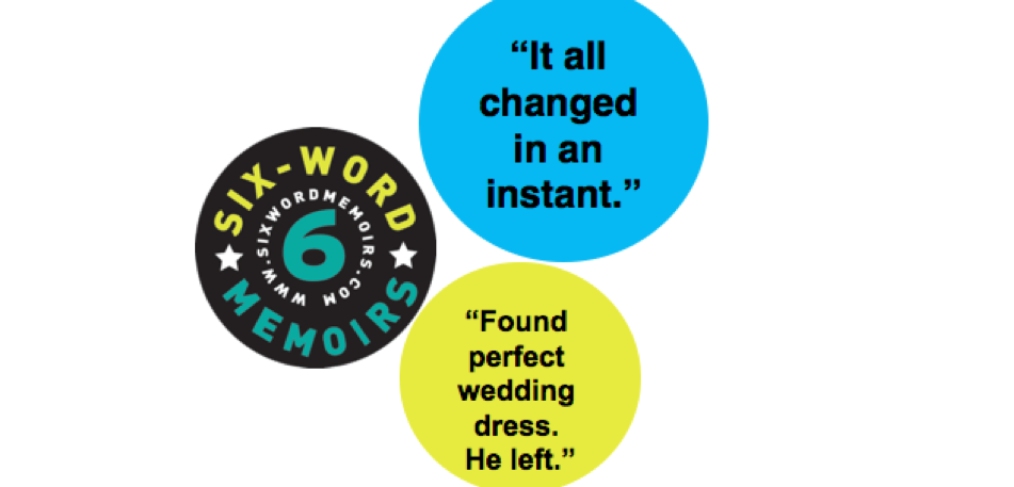
So, what if you only had 6 words to tell the story of your life?  According to legend, Ernest Hemingway was challenged in a bar bet to write his memoir using this “short short novel” method. No one knows if he ever did it, but Smith Magazine challenged people to take it on, resulting in a project with over 250,000 memoirs.   It’s minimalism at its best.  Check out these powerful stories from people, some well-known and others, not so much:

“Father: ‘Anything but journalism.’ I rebelled.”  –– Malcolm Gladwell

“Live man’s life in woman’s body!”  – Diane von Furstenberg

“God, how long was I asleep?”  – Christopher Rumsey

“Wanted a pony, got a goldfish.” – Gretchen Cline

“I picked passion. Now I’m poor.”  – Kathleen E. Whitlock

And, my own:

Attended anti-perfection class. It worked.

I even challenged myself to get simpler and came up with this one.  If you know me, it really does get to the heart of my life so far:

Home is right here.

Give it a whirl.  Take out a pencil and paper – a bar napkin if you want.  What six words describe your life?


Busting Up A Tired Mindset

Everyone’s grappling with change, seeking to identify and validate a new set of rules for business success.  All roads seem to be leading toward a need for businesses to be more “human” and “social.” Seems simple enough. Yet, I think we’re still talking around it all, just scratching the surface for what it really means. My intuition tells me these are Big Thoughts with huge implications for how we market and do business.  As I struggle to get my arms around them, I’ve started to realize that the limitations of my thinking — and perhaps the mindset from a traditional marketing background — are holding me back.

I don’t pretend to have the answers.  But I’m going jump head first into an attempt to start to make some sense of it all.  How can we connect the dots between what seem to be somewhat vague concepts to form a new vision of social enterprise that creates value for all?  That’s no short order. Something tells me it won’t be pain free — perhaps challenging all my pre-conceived notions about the role of marketing and brand.  So, I’m going to start by busting up a few notions that, while may seem obvious, are important to identify and dispel.

Social Is About Relationship, Not Media

Social this and that is ubiquitous. If Jan Brady could chime in, she’d probably just sigh, “social, social, social.”  The conversation, however, is an important one: informing how we’ll organize and engage to do business, get things done and create value. So, we find ourselves talking about important and related topics focused on technology, media, currency, value and economy.  This makes perfectly good sense. And yet, I’m left feeling, well, empty. Like I just ate a huge meal, only to pop up a half hour later still hungry, looking for something more substantive. So why am I having such a hard time understanding how all these concepts all fit together? Maybe a good starting point is realizing that these topics are a little off for understanding the heart of social beings: the role of trust and relationships.

The discussion has been diverted, in part, because it all began with social media.  We buried the lead and the great disservice is that it’s set us all up to think incorrectly. Here’s why: when we hear “social media” our brains, or a least this one, initially heard the word media. The broadcast-out variety of television, radio, and print.  This really confuses the issue. I mean, seriously, can you imagine coining the phrase, “telephone media?” The phone is simply the host, the means, for a conversation. What most of us have done is place a limited framework and business model (an old-school broadcast advertising based one at that) upon our association with the word social.  Who are we kidding?  As marketers, we were thrilled to find another channel for outbound marketing, since so many other doors have been slammed shut. Unfortunately, we’re now spending our time backpedaling to remind people that, in fact, that’s not what social is even about. If you want to engage, we’re told, it’s all about two-way dialogue.  Isn’t that a ridiculous and elementary thought for anything called social in the first place?  And yet here we are, still talking about it. To leap forward will require breaking free from advertising-based thinking as we know it to start focusing on building real relationships with people.

We’ve Been Hiding Behind Marketing?

During the recent BrandsConf, digital strategist Dave Wieneke commented that we can’t hide behind marketing like Oz behind the curtain pulling all the strings. I’ll admit it: the statement made me recoil in slight self-defensiveness. My cringing comes from the core implication of the word “hiding” — that marketing is somehow less than noble and honest. That’s not a very appealing thought to attach to one’s profession and it’s never been at the core of my own desire to portray anything as less than authentic and real. But, to recognize my own bias, I realized I’m probably still holding on to some long-held notions of what core activities are involved — and still adequate — for connecting products and services with customers. A more social and human business may require different approaches and mindsets for understanding consumer behavior, motivations and drive than I’ve traditionally considered. Maybe I’d have to identify and challenge all my existing notions to expand my thinking?

To be honest, I must dig deep to understand the frameworks to which I’m clinging, because I love brands.  Love them.  In all their glory: the promises, the aesthetics, the stories and (gasp!) even the ads.  But here’s the rub: the key to building lasting relationship isn’t found in organizational, big-brand messaging to the little people.  It requires we step out of the corporate ivory tower and into a real relationship with people.  The faceless mass of “consumer” should have a real name and a life in which we are engaged. Not superficially, but for real. You know what’s amazing about Zappos? Tony Hsieh is accessible. Send him a tweet and you’ll hear back.  He’s not hiding behind a massive façade of corporate PR and customer service mantras. He’s not superficially making claims behind a tagline. He’s living proof that you can come out from behind the curtain and it can be a real advantage.

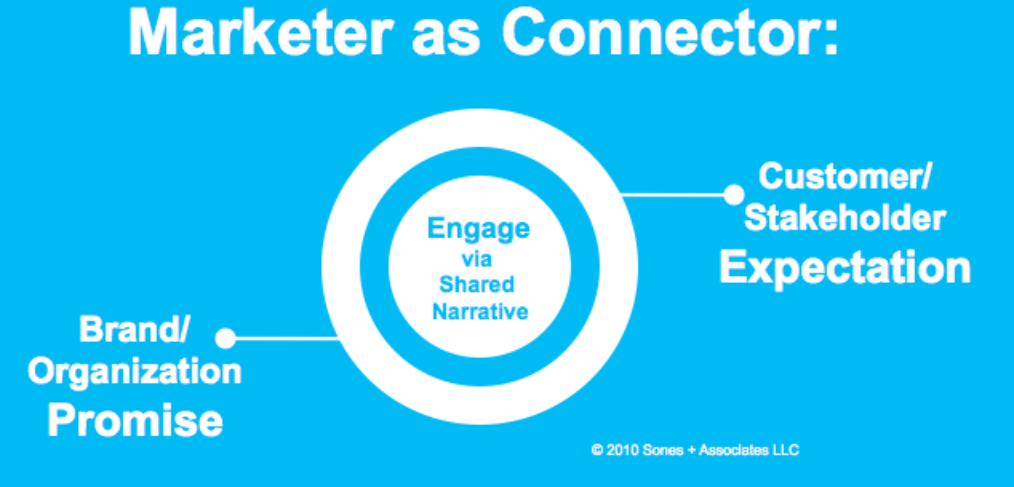
So, if we peel away the layers of marketing and brand what do you get? People. Promises. Expectations. All interconnected by relationship forged through trust and a common bond of shared narrative.  If we’re honest (why stop now?) this can be scary. Because it’s going to expose us – anyone in a business – and require us to be “out there” like never. Open to criticism. Mistakes. And all our humanness. But the rewards can be bigger than ever.

What’s holding you back?


Strengthening Performance through Story

I’ve encountered people who raise an eyebrow and scoff at brand storytelling as an unnecessary “soft” approach. They argue that, instead, we should be focusing on hard “measurable” tactics such as SEO, keywords, and traffic.  But I say, why not both?

Many marketers these days are focused on “performance” of their blogs, landing pages and offers. I, too, have attended webinar after webinar about these very topics. So, fair enough. But here’s the catch: many people get really caught up in this and fail to also focus on the story that people will encounter when they are reached. And, by the way, if you don’t give them a story – then they’ll create one for you! Internet marketing and brand storytelling doesn’t need to be a one-or-the-other proposition. You can have your cake and eat it too. In fact, I think a unified approach will make the cake taste better. Here’s why:

Your story separates you from the pack.

So, if a desired result of great SEO, keyword use and other internet marketing techniques is about “getting found” then what happens when that’s achieved? If you fail to tell your brand story, then you lose out on leveraging your key point of differentiation.  Your story is what really makes you unique and holds the key to your natural authenticity. It’s what makes you memorable and believable. With so much white noise, “sameness” and intense competition out there, can you afford to ignore it?

It reminds you to think about your audience.

Creating shared narrative is also an integral part of the marketer’s role as connector. Does what you have to say resonate with meaning and relevance to inspire action?  Successfully pulling this off requires thought about the audience: how can you provide them with a means to see themselves as participants in the story? The Whole Foods brand story, for example, provides customers with a way to impact the world.  When I buy organic, locally grown food from Whole Foods I’m the hero (wait, I think that makes Whole Foods an enabler too!).  And that makes me want to go back again and again. I say any opportunity to think about your audience – and how your brand fulfills their emotionally driven needs and desires — is a good thing that will improve your marketing.

What’s performance all about anyway?

I believe that placing an emphasis on your brand story will enable your internet marketing efforts to shine, making them efficient and effective. Think about keywords for a moment: can the very process of examining your story and its recipient offer clues to help you in the search? I also believe that telling your story through a body of work such as your website, blog, Facebook status updates and Twitter stream, can help people find these golden points of connection. If internet marketing tactics serves up a sales “starter”… maybe story is the “closer?”

So, don’t argue: enable. Tell your brand story to resonate with people, helping them find a role for themselves in the narrative. And use all your best practices in internet marketing to drive them to it. Within this approach is the key to engagement, connection, loyalty and even buzz. And who doesn’t want that result?


My Brain Made Me Buy It: Decoding Memory and Response

Martin Lindstrom’s newest book, Buyology, is a great introduction to the world of neuromarketing. He presents insight into how our brains really react when we are exposed to advertising, logos, brands, products and other stimulus by testing thousands of people hooked up to MRIs, in the world’s largest neuromarketing study, to see what really happened. The results challenge common marketing think behind why we buy and what motivates us to action.

Psychologists understand that people act on emotion, but rationalize it later. Our buying patterns are no exception: why do you think the impulse buys are located at the cash wrap in a retail store? Act now, rationalize later is our unwitting mantra. But what really influences the purchase decision? What’s going on in the depths of our minds to impact these decisions? And, are we even aware of them?

The answer: a LOT that’s mostly subconscious. This book provides proof for what I’ve long held as obvious: much of today’s advertising is generally an ineffective way of influencing people. Before the Mad Men jump all over me, I’m not talking all advertising. But tell the truth: what’s the last tv commercial you can recall?  What brand was that anyway?  Lindstrom takes this to task through extensive research to identify how and why our brains respond and recall. And if we don’t recall ads, what do we remember?

Lindstrom provides insight from his findings with lessons for how we can better craft our brand stories and their corresponding experiences. For example, think brand evangelism is just business speak?  In what he describes as a controversial correlation, Lindstrom reveals that people who belong to faith in Christianity responded similarly in tests to those who are mega fans of a brand, such as Harley Davidson. That is, their brains fired in a similar fashion.  This, he believes, should prompt brand builders to consider, “Do we have a strategy for how to adapt elements from the world of religion?”

I don’t want to give it all away, but here’s another interesting example of his findings:  when a smoker reads or hears the word “smoking” the section of the brain triggering addiction lights up like a Christmas tree. The result? All those PSA’s on the dangers of smoking makes the smoker crave a cigarette. Sounds about right to me: just mention the word “diet food” to a friend of mine and she says all she hears is “food” and wants to eat. Phillip Morris, Lindstrom notes, also creates “red” environments in nightclubs to subconsciously trigger a desire to light up a Marlboro. Brand color strategy is important and can impact the way we are captivated and respond. This provides added credibility to a story I heard from Pantone, an authority on color, about the new-found popularity of brown. Ten to fifteen years ago, when prompted to provide a word association with the color, the resounding top responses were “mud” or “dirt.”  Today, it’s “rich.” Why? Thank Starbucks coffee and a renewed popularity of dark chocolate. Seriously.

On another note, it’s more than a little disconcerting that a tobacco company, Lindstrom’s client funding the studies, is pioneering the field. I guess that’s to their credit for finding a way around regulatory banishment from advertising. Yet, there’s all sorts of worry and concern that is being raised over the ethical use of these discoveries. All that aside (it’s for another day, another discussion), Buyology is a worthwhile read and a great intro to neuromarketing. It’s prompted me to dig deeper into the connection between neuroscience, buying behavior, branding practices and (surprise!) the role of stories. How can we craft the brand story to increase value to customers? Lindstrom himself notes, “The story around your brand means everything.” He’s now giving us some great insight for which parts resonate and why.


Info is Free. So, Now What?

“What happens when clients don’t want to pay for information anymore?” This was a question postured by a friend and fellow consultant recently over a Thai dinner as we were discussing all things career, marketing, brand and future-is-now. The notion hit me like a lead balloon and I’d like to think it was the hot chili peppers that made my eye tear a little…. But there it was. The fact that “information is free” was provoking a healthy dose of fear and panic. In my mind, I immediately had visions of the old abandoned factories where my grandparents once worked.  Did they see thatcoming? And, now that the information age is here, what happens to us if the heart of what we provide is available everywhere, for free? I wiped the tear from my eye, listened to my friend and now conclude: information ain’t where it’s at!

“Free.”  It’s the great-marketing-and-sales concept of the moment. The idea: give away your products/service and the prospective customer will be so happy with the value that they’ll come back for more. Entrepreneur and info product guru Eben Pagan calls this “Moving the Free Line,” challenging businesses to give their very best ideas and concepts, to move the line to unsurpassed value and customer loyalty. This goes, I believe, against the protection-minded grain of the “save the best for last, don’t give it all away” thinking engrained in most of our business minds.  Add the internet into the mix, and today there’s an abundance of “free.” Info is everywhere, for the taking. I think that’s just fine. Why? I’m going to step out on a limb here and say I think my value to clients is about something bigger than just information. So the more they know, the better we can work together to impact their success. And, yep, sometimes the old-fangled notions creep into my thinking and make me fearful about protecting my intellectual capital.  Ever had anyone tweet your ideas without crediting you? See anyone incorporate your ideas into a blog, with no reference? Been there. Guess what? I’m still breathing and so is my business.

“Imagination is the new source of value in the new economy.”-Tom Peters*

As consultant or service provider, I believe it’s not enough to just put forth information. You must have a point of view. A big idea. And creativity. This also requires, to some degree, a shift toward a role as teacher, trainer, and trader.Today’s world requires a mindset for sharing and collaborating to investigate: what can we create with our knowledge? How can we reinvent and transform your brand, your business? Tom Peters reported, back in 1994, that knowledge grows obsolete every half dozen years or less. Given this predicament, the climate of our ever-changing and uncertain world, a high level of competition thanks to the flattening of organizations and, of course, easy access to information, I’d say: the world changes so fast why not share your ideas abundantly? I see it as a criterion for survival, in fact.

So, as a work-in-process, I will challenge myself to increasingly incorporate the following, in creative and big ways, into my work:

Give with heart. Seriously, this isn’t a new concept – it should, I think, be a guiding principal for life. Yet, it’s sometimes tough to remember when we are in the dog-eat-dog world of making money to pay the mortgage. I really do believe that we’ll reap the rewards of giving unselfishly. I’m not saying you should work for free, but just that you might want to consider helping others with sincerity, just because it’s the right thing to do. Maybe you won’t get a new customer, but if you do this right, you can create value in everything you do. I personally think there’s enough business for everyone, so I’m not concerned about competition (and realize some people would have a field day with that comment!). Or the notion of “fairness.” I’m not fearful of people taking advantage of me, either.  I know what I can offer for free, and I’m willing to share…. That doesn’t make me a patsy, by the way! It’s a choice, my decision to make. And yours, too.

Fearlessly put ideas out there. In Babson College President Len Schlesinger and Charles Keifer’s forthcoming book, Action Trumps Everything, they suggest a need to move from thinking to doing. They say the mode for entrepreneurs operating in unpredictable times is to Act. Learn. Repeat.   Putting your ideas out there will help you learn, adjust and even expand your thinking. If we wait until everything is “just perfect” or all tied up in a bow, chances are, the market will move on.  And, if we protect new ideas and concepts – keeping them safely in a box to sell, we risk that no one will ever really know what our unique approach can mean to their business. I say, throw away the notion that putting your ideas out there for free can eliminate business. I think it’s the opposite: sharing will help you learn and attract potential customers. It’s not just information, but the sum of your whole package that people will want to engage.

*Note: I’m not sure exactly to whom this quote should be attributed. I believe Tom Peters was the original source and have notated it as such, although I heard it via JulieAnn Turner and, since, have found it highlighted in a few other places, too. The irony of this issue, as part of this post, is not lost on me!

Keith Partridge, A Salad Bowl, and Me (ROI of Storytelling)

The following is my contribution to Raf Steven’s new book, No Story, No Fans.  It’s a bit longer than the usual post… but presents an important topic that most of us in marketing and branding are expected to address: what’s the ROI of Storytelling?

If you visit my home, chances are you’d realize that pretty much everything has its place and utilitarian purpose. Having moved quite a bit as an adult, I’ve been fairly good at keeping stuff to a minimum and to those things that I really use. This makes even more sense when you learn that I live in an older rural American home, built in 1885. The home didn’t originally have closets, so the only two that exist today were built during recent renovations. Yes, a woman with just two closets. I have, however, a confession that belies this practicality. If you peer into the large freestanding cupboard where I keep my kitchenware, you’ll see it:  an old, worn out wooden salad bowl with matching, broken serving utensils. It just sits there lonely, neglected and unused. I paid rather handsomely for it about six years ago in a moment of whimsy, coughing up $52 plus change for an item I inevitably would never use. Why? Because of its back story. This wasn’t any ordinary, old salad bowl set. No, this little beauty was right there in the middle of my Friday night childhood entertainment – passed about between Keith, Laurie and Shirley on quintessential 1970s American family television. This salad bowl, now my salad bowl, was a Partridge Family salad bowl.

Had I seen this hunk of salad serving junk at a random yard sale, I guarantee I would’ve passed it right by. It’s a pretty plain, old, ordinary mass-produced salad bowl (and not really a nice one at that). I made the purchase fully intent on using it, rationalizing how serving up my little piece of TV history would overshadow my inadequacy as chef. But when this little gem arrived with a “certificate of authenticity” from Ellis Props, I gave it second thought. How could I use it? The salad bowl suddenly increased its value in my mind (not that I’d consider selling something that touched the hand of a Partridge….). In my enthusiasm, I even spent an evening watching old episodes on DVD, just peering for a glimpse of my bowl, our bowl. No luck, but I swear I really do remember watching Laurie Partridge tossing a salad with it….

I tell you this salad bowl tale because I think it makes a great case for the role of storytelling in business. Collectors and sellers of memorabilia (derived from Latin meaning “associated with matters or events worthy to be remembered”) have long known the value of a good story attached to a product. It creates meaning and value for people, even when the object is seemingly utilitarian. A back story of meaning and relevance, whether for product or service, gives people another reason to care. This bond, a shared narrative between you and your customer, can achieve all the great things that marketers desire:  loyalty, buzz, advocacy and engagement.

The value for connecting with people through story isn’t confined to memorabilia. Witness the success of the Significant Objects Project, which set out to specifically examine the value of a product’s back story. The project pairs a writer with an object purchased from a thrift store or garage sale for just a few dollars. The author then writes a fictional story about the low-cost item, making it “significant” through a contextual back story, and posts it for sale on eBay. My favorite, for example, is the story of a $2 small metal bottle opener shaped like a hammer that became the symbol of one retired Navy veteran’s strength and power. The resale value: $40. The bottle opener wasn’t a singular success, as the selling price of other objects inflated after association with story. The overall return for the items purchased and storied: how’s a 96% margin? Some $128.74 of random stuff transformed into sales of $3612.51 (with proceeds donated to charity). Proving that one man’s junk is another man’s treasure, thanks to the added value of a good story.

“But I sell tile grout” you say?  OK, so you don’t have to focus on your story as part of your marketing strategy. But I think you’re leaving an important marketing and sales tactic on the table if you fail to employ it, no matter what kind of product or service. Consider the closely related parallel we can draw with product design: as manufacturer and marketer you can choose to emphasize design as an asset. Or not. Regardless of your choice, design will still be at play as a fact of nature. All products have an embedded design. The attention you pay to it, however, can be great means for differentiation and added value. Witness the transformation of the $.99 flyswatter, recreated by designer Philippe Starck as a successful $19 mass-produced, household item. That’s a pretty good case study for the value of repositioning a product for higher value. I’m thinking the financial managers liked it too. Like design, story can similarly provide a boost for your business.

Author and educator Pleasant Rowland understood this concept well when she created her company with a simple concept: to provide girls with an alternative to existing dolls. The “American Girl” dolls represented fictional characters from different periods of American history, each packaged with a book to tell the tale at a premium retail price. The accompanying stories struck an emotional chord with Moms, who purchased $1.7 million worth of storied dolls in the first year. By 1998, Rowland sold her “American Girl” franchise to Mattel for a reported $700 million and it has since expanded to include publishing, retail stores, digital media and more. The stories behind the American Girl characters gave the dolls meaning to legions of little girls and created a significant point of differentiation and value in the marketplace. Without the story, the American Girl would’ve just been another doll on the shelf. How’s that for a return on story investment?

Whether you artfully integrate your story into your marketing strategy or not, stories will be told about you, no matter what your industry, product or service. They are embedded in your reason for being, providing a rationale for your position in the minds of people. Your story supports and helps define your brand identity, so why not take time to pay attention to it — editing, crafting and shaping it in a way that increases the value of your offerings? Every business has a story. So why not dig it out, dust it off and purposefully use it?

And come to think of it, maybe it’s about time I served up a Partridge Family salad for dinner after all.


The Joy of Conversation

What are the ingredients of conversation?  As one who was recently invited to a Meetup event for introverts (something I find as a seriously funny notion), I’ve been giving this more thought. Don’t get me wrong. I’m not really shy. I’m just, well, a bit reserved. That is, walking into a crowded room of strangers at a cocktail party isn’t necessarily my favorite thing! I’ve always been fascinated by people who can do this with skill and ease. Its made wonder: can we be taught to have the gift of gab?

And then I met Timothy. Timothy Johnson III:  my new twitter buddy and a self-professed “conversational engagist/rapport builder.”  We met up recently to discuss storytelling, marketing and the conversation inevitably strayed to…conversation. Timothy loves to talk about talking and he’s brought it to a new level: we wondered and debated, in this rushed, pressured-to-perform, digital and sometimes impersonal world, has the art of the conversation been lost? What is a good conversationalist? For me, I thought this was an interesting opportunity to understand and gain some new ideas for improvement.

Why does this matter? Conversation is a precursor to relationship building. It goes without saying that networking and connecting with others is a core business competency. And, as brand storytellers we can’t achieve the goal – shared narrative with our customers – if we don’t have a meaningful one. So, it’s worth examining what’s really going on during the process of meaningful conversation. Here’s the takeaway:  people engaged in dialogue are constantly sizing each other up, making little judgment calls to answer the question, “do I trust and believe this person?” Trust is the glue that binds a relationship, part of the reason we also choose to do business with others. As a sales rep friend often loves to tell me, “I ain’t buyin it if I ain’t buyin’ it.” Eloquent? No. But true, yes.  And, by the way, this is also a key for success in social media.

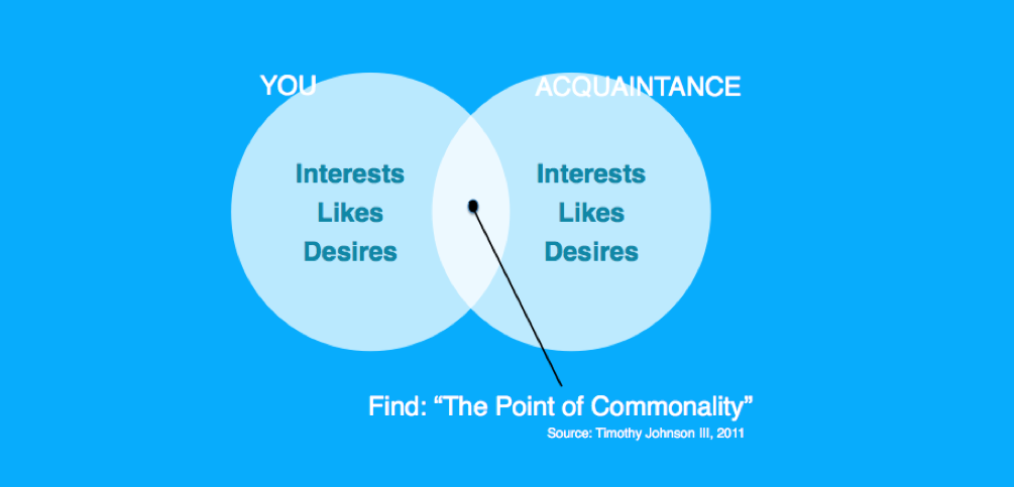
So what did Timothy teach me? As he started to outline the elements of a conversation, in a neat little Venn diagram, he talked about “finding connections with people.” Aha, I thought:  shared narrative. Relating. OK, I get that. He spoke more about how he goes about this. But beyond the technicalities of it all, the broad smile on Timothy’s face revealed the real silver bullet: you have to love it. OK, not dying love or anything, but you have to possess an earnest desire to really connect with people, really find out about them to be successful. Find the joy in getting to know people. Great conversationalists, I thought, are really just starters. And then they transition to good listeners.

I’m pretty sure I can do that. What about you? Maybe there’s hope for that introvert Meetup after all.